AVIF is an innovative online charity assisting with sustainable development via online and onsite volunteering in Kenya, East Africa. Being virtual means negligible administration costs for worldwide impact. We believe in efficiency, honesty and transparency .. oh and we do not charge fees.
Thursday, July 08, 2010
Love it when a plan comes together!
Wednesday, July 07, 2010
is with Ben and the
Tuesday, July 06, 2010
Biogas from AfriGadget
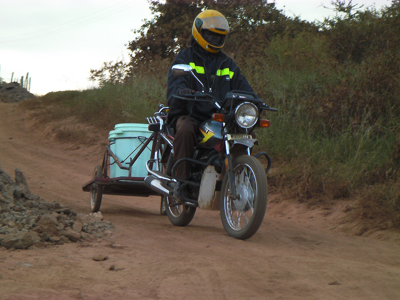
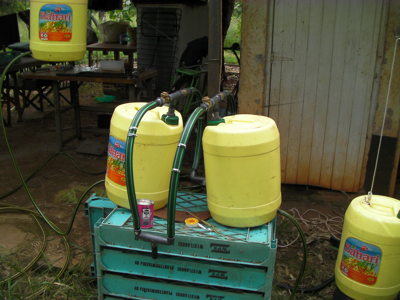
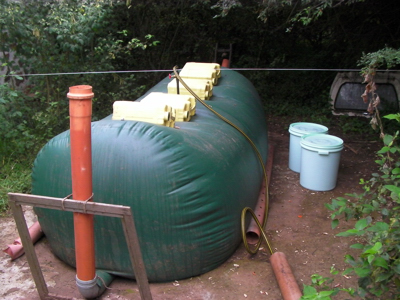
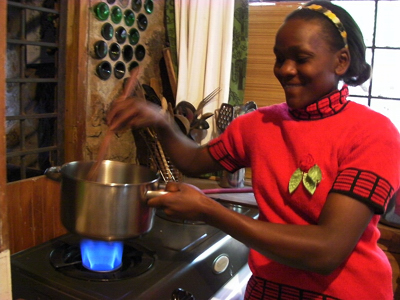
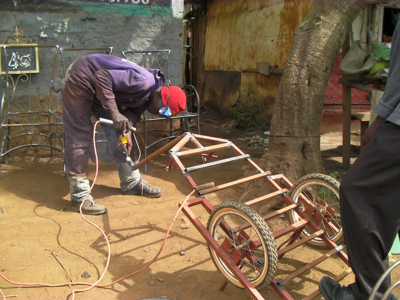
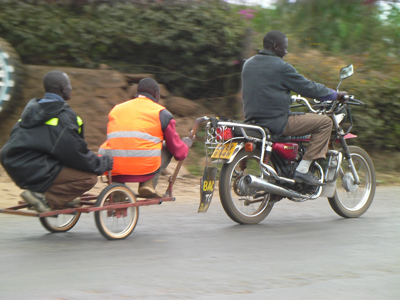
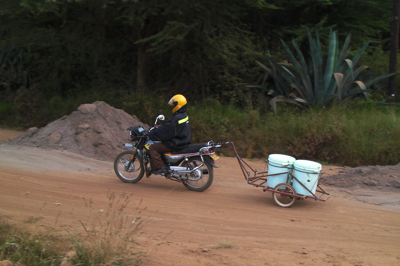
| Poop piki piki for my biogas system Piki piki means motorbike in Kiswahili This gadget was created to solve a real problem with biogas – getting the dung to the system quickly and efficiently. Motorbikes are the taxi’s of Africa so why not? Before I tell you about the above gadget I just want to remind you about the problems we have been having to solve to get the biogas to work at home. Installing biogas at home has a real experience in afrigadget – we have figured out by trial and error how to get the gas under pressure – At first we tried using water pressure, but when we stepped back and looked at it we realized that it really wasn’t simple or appropriate for bush applications .. In fact, all we needed to do was to put pressure on the bags. The pressure wasn’t enough to run the stove until we modified the stove jets by enlarging them slightly. Next we had to figure out how to get the dung to my digester – you see I don’t own cows but my neighbors who live a few kilometers away do and are selling it at a very nice rate of Ksh 50 (70 US cents) for two large buckets . The owners are happy to see the dung as it accumulates in the nighttime stockades and attracts annoying flies that carry diseases if left on the land. The problem I face is common to many folks around here, we rent houses but we don’t have livestock. But there are huge cattle farms around us. So Dominic came up with a solution that creates jobs and moves poop quickly and efficiently. So we went to the local juakali welder on the roadside to create a dungmobile ..a trailer designed specially for cow dung! We tested it with a human load to ensure it is balanced … each bucket weighs about 50 kg. And the first delivery arrived without a problem! I know you are wondering, if it’s that easy, then why doesn’t everyone use biogas? Now that I’ve got biogas running my kitchen I wonder why so few people have done so in Kenya. There are countless articles, publications, websites and people who will tell you that biogas is the most economical and environmentally sustainable way to produce energy. In fact, the benefits of Biogas have been known for tens of years, and hundreds of systems have been built in Kenya. But it hasn’t really taken off – few of the installed systems are actually working and the uptake of biogas systems at a domestic level has been slower than slow – it’s virtually non-existent. A review of biogas in Kenya reports that technical breakdowns has discouraged uptake but the main limiting factor is cost. Here’s a simple comparison of costs – from continuing using charcoal/fuelwood or Kerosene and LPG to using various biogas options.
For a simpleton like me these figures are immediately revealing – it takes 2 years to pay off a flexibag digester after which domestic fuel is free for at least the next 10 – 13 years. For the underground systems you have got to be hugely rich, or suffering from environmental guilt to make the decision to switch to biogas – from an economic perspective it will take 10 to 20 years to pay back. You could grow your own trees and make your own charcoal in that time frame…. Why is it so expensive for the constructed biogas systems? Because most of the biogas systems in use are constructed systems requiring engineering and masonry, they are very expensive, take weeks to install, require experts, and intensive follow up. If they go wrong it’s a major engineering task to fix it. This is why we are promoting the flexible bag option for domestic and small industry use. Congratulations to Skylink Award winning Kenyan biogas innovators We would ;like to congratulate Skylink Innovations who have just won a the Ashden 2010 Award for their biogas installations in Kenya. I thought skylink was an airline… Biogas operated planes??? Their industrial scale system costs Ksh 1.6 million (US$ 19,753). Such installations may need to be financed by the Government institutions where they clearly make enormous economic and environmental sense for schools, prisons and other large institutions. For small scale house hold units, we need solutions that will compete against the cost of installing LPG or using charcoal, firewood or kerosene stoves. When we talked to local Maasai near Nairobi they found the flexi bag systems appealing because they could be purchased with the sale of just 2 or 3 cows, can be rolled up and moved when they migrate, and it saves the women the work of searching for firewood, it’s hygenic because water can be heated for bathing children, while it also removes dangerous piles of rotting cow dung near the homesteads which are breeding sites for biting and disease carrying flies which affect livestock and people. |
Delays on drilling
Its looking like we'll only be at "hydrogeological survey" stage by the time our volunteers reach Amboseli. Staff of Hope will be on site but, as with everything, if there aint no cash .....
Its such a hard time to be fundraising right now, but we continue to search for the cash needed to sink the borehole well in Enkito village. If you can help, please get in touch.
Saturday, June 05, 2010
Brilliant!! Kudos to
Friday, June 04, 2010
Help us bring water to Amboseli
Sunday, May 30, 2010
Testing the awesomeness of Posterous
The internet is a myriad of ...I'll say goodbye to the Twitterers now unless you click the short code?
I'm writing this post to try and get my head around how complicated this is going to be. This post is "apparently" going to appear instantaneously all over my rather large and complicated net presence, namely; Twitter, FaceBook, my FB charity page (not the group though???), LinkedIn, Friendfeed (which could then cause infinite duplications), Plurk, Flickr, YouTube, Delicious and both the old AVIF blog and the KO2 blog .. (breeeeeathe) .. but not the main AVIF website. I won't bother putting links to all these "profiles" / places because this article is actually going to be published on each one of them, apparently?
So that means that personal stuff I want to share will go all over the place but AVIF's website articles will still have to be added separately, same with postings for the FB group (annoyingly) which still has more use, in my opinion, than a FaceBook page. Posterous also doesn't allow you to utilise FB's powerful tagging facility whereby sticking an @ sign infront of a name automatically tags the person, group, page, application, service etc. But if I stick hashtags everywhere perhaps I can throw it around #Twitter a bit more e.g. #posterous #facebook #bla bla bla
Let me get this straight? If I want to throw something out wide across the net I use Posterous, right? But then the Twitterers aren't even reading this part unless they click the short link several hundred characters back in this post. Surely the thing that keeps social media buzzing is social i.e. personal i.e. REAL stuff .. which you can't get in 140 characters .. how many Twitterers have actually clicked the short code and are actually reading this?
Do I simply use Posterous from now on? ..which is crazy as the whole point of Posterous is that I'm sending you this by simply writing an email in Gmail??
If I attach a little image too they'll somehow pass that onto you, although via email i've no idea where it'll go (at the end maybe)?
So .. let the learning curve continue ...
Wednesday, May 26, 2010
Sinking a borehole in Amboseli
There was "a relocation, in February 2010, of 7,000 wilderbeest and zebras by the Kenyan wildlife Service to Amboseli National Park, famed for the spectacular views of Mt Kilimanjaro and the elephant population....
Last year, the drought left millions hungry, killed livestock, evaporated lakes and streams and .... Amboseli was severely affected ... 60% of the zebra and wildebeest population died, severely compromising the ecological balance of the park and its surrounding areas....In addition, the drought took 50% to 80% of the Maasai cattle herds. Predators lost their prey base and lions, already critically endangered in Kenya, also faced starvation, so they turned to killing the few remaining cattle and other Maasai livestock...
The initiative will ensure the preservation of the ecosystem in the Amboseli. .." [link to article]

To help the village to avoid these problems and other water conflicts we'd like to help by sinking a well in the village. Quotes are coming in at anywhere from $100 - $4000 but I'm sure with the maasai labour we can hire the equipment and expertise to do this for much cheaper. We're also getting "Extraordinary" help from a source I can't reveal .. yet! .. a fantastic new service to non-profits we're working with.
If you know anyone who can help during August, or wants to sponsor this project, or knows a company that would like to offer support, please let us know.
Create your own video slideshow at animoto.com.
Monday, May 17, 2010
In Rabuor its the chicken before the egg

my visit in April and Tony Odek, director of the group has now updated us with progress on the poultry farming operation started up with the funds.

They have constructed a secure, free-range area and purchased feeds, chickens, vaccines and equipment as well as employing a caretaker. There are 50 chickens, most around 2 to 3 months old now and by the time they are producing eggs and offspring the start up funds will be depleted and the operation will be sustainable, providing meat, eggs and income for the widows looking after the children.
Thursday, April 29, 2010
A new host maasai community in Amboseli
View Larger Map One of the night watchmen there is a Maasai called Jackson. He works at Stilts and travels home as often as possible to help provide for his family. While i washed our ridiculous amount of clothing, after arriving from climbing Mt Kenya, we spoke for some time about his village in Amboseli National Park and how Cecilie (a Norwegian friend also staying at Stilts) had visited there. For "muzungu" Jackson's village is a paradise. Life there is very different and very simple, in fact its an entire education and we'd like to offer that experience to our AVIF volunteers.

If you'd like to experience Amboseli and stay with Jackson's community, perhaps help them to improve their water supply and basic education for their children, then please get in touch.
[Jackson 2nd left]


Asante sana Cecilie for these photos.
Tuesday, April 27, 2010
Amazing subjects amazing photography

..across from the main primary school which will also be the project site for the US environmental project with Charles Abramson's team at Terra Endeavours, producing algae and multiple outputs for the community including jobs, electricity, cattle-feed, income-generating high-protein nutritional supplements and much more.

This project alone was worth making the trip for but also, seeing faces like this makes Kenya so special.
Kenya is such a beautiful and diverse country

[looking down the Mara River) ..and what an amazing variety of host communities we have .. including a new Maasai community next to the Mara Sidai tented camp. Anyone wishing to help this community should expect to provide english lessons (in return for Maa lessons) at the local school and if living in a dung, fly-ridden house is too much of a leap for you, Mara Sidai can welcome you for 1500/- a night. Located 250 km from Nairobi and just 45 minutes by air, the community sits in the Maasai Mara, the richest game reserve in Kenya. Tony Ole Lentumo is one of the manyatta's head Maasai. Having visited his home and spoken at length with him it seems the main problems his community have, despite a wealth from selling jewellery and giving visits to tourists, is that they still have to travel up to a kilometre for water, something I found amazing when Mara Sidai has ensuite, tiled bathrooms in their tents!!!! Reality is that the rich tourist camps do very little to assist the locals just outside their gates, despite the locals (and of course the wildlife) being the very reason there are tourists.


Oloolamutia Primary School also struggles with finding good teachers for the children. Though Maasai children will normally go on to inherit their famiy's cattle, goats, land and lifestyle it is still important for them to have a basic education. Contact us for more details.
Mona's work continues fantastically with projects and major results almost every week. Rukia's new house has been completed and there is already fundraising going on to help a young pair of brothers in the community.
Everything we've achieved on this tour, is a result of the innovation and resourcefulness of our communities and volunteers. The internet makes it so easy to connect with truly amazing people and, although of course I'm biased, I highly recommend visiting Kenya to volunteer.
I'd like to thank the following people for making my trip incredible :
Sharon Argwings Kodhek, Amanda Flanagan, Daniel Keya, Michael Ouma Nam, Edward and the girls at Mercy Home, Charles and Prisca Adero, Edward Wata, Mona Bankhaug Sundli "for running around to furnish 2 brand new and still wet mud huts for us "!!!! .. also Maurice and his wife for feeding us at midnight, Douglas Onkware, Jessie from Upper Hills Campsite for recommending Mara Sidai, the Kichwa Tembo ridiculously gorgeous and expensive hotel for giving us free cake, a drink and tame Timon and Pumbas to watch wandering around the grounds while we rested by the pool and gave the car a break! ... for all the people that "blessed" our trip and kept the rain away despite it being the rainy season, because we'd have been grounded in the rain in the Mara, the convent Hotel of Kisii for lending us their washing lines and laundry staff for free, Michaels entire family for waiting with us while the car was fixed after we bashed it to hell on the Mara potholes, to Mary and John Kariuki and the incredible bionic porters for a truly awesome climb of Mt Kenya (especially John for being so understanding during the tears at 4,750m while we threw my Mothers ashes into the wind) ...... massive thanks also to Andy Barbour of Stilts Backpackers in Diani, a place I highly recommend to all volunteers to at least go unwind at for a couple of days.
I want to finally witter on about the importance of NOT under-estimating malaria!
Without prophylactics you WILL get the parasite and it is NOT pleasant. Doxycycline is a cheap anti-biotic and anti-malarial but has side effects of causing nausea on an empty stomach and increased skin-sensitivity to sunlight. Malarone (atovaquone) is also very effective BUT EXPENSIVE. If you opt for Malarone then purchase your 1st weeks supply but buy the rest in Kenya it is much cheaper there. Any decent pharmacist will stock it. Use nets too and lots of deet spray in the evening (P.S. Deet and nail varnish do not work well together LOL !!)
Wednesday, February 10, 2010
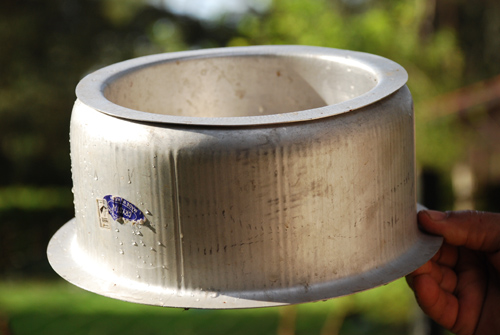
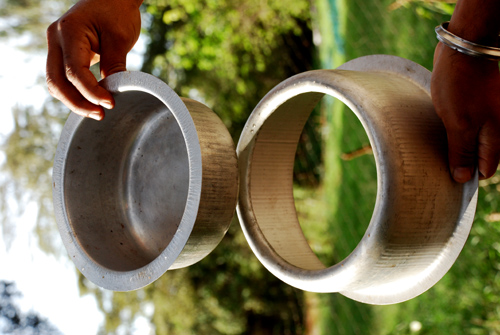
Fuel saving Sufuria

This is what it looks like when assembled


Dominic Wanjihia has been previously on Afrigadget showcasing his flat parabolic mirror, container garden, wearable Solar Panel vest, Food dryer, and camel milk cooler.
Thanks to Erik for posting.{jcomments on}
Thursday, February 04, 2010
The first of 2010's volunteers arrive safely in Kenya
They were also joined yesterday by 2 Facebook friends and volunteers for an australian youth sports organisation that provides a "unique non-violent way of disciplining kids through mixing sport with social skill development". Imbuhira (2nd right) and Ruthy (centre) work in the city and volunteer whenever possible. We're hoping to link up Ingrids into the youth sport activities as well as assisting Michael Nam's football academy in Naivasha.

We'll be updating you regularly but you can click onto the FaceBook group for more photos.
Monday, February 01, 2010
Kick it back to Kenya

Last Summer Philip (centre of pic), a PE teacher at Catcote School in Hartlepool, volunteered in Naivaisha, along with colleague, Andrew (right), delivering football coaching sessions and assisting with a local man's dream to create a football academy for the street kids.
They made strong links with the coaches over there, including their FIFA-trained local host, Michael. All three see football as "a fantastic tool to help the children develop socially and physically".


Since his return to the UK, Philip has been discussing the issues he witnessed with his own pupils, who decided they would like to help. As a class they decided on the project name ‘Kick it Back to Kenya’. They hope to receive donations of old boots, shirts, balls, cones "anything that you might consider to be worthless could be priceless to a child". They have posters around their local sports centres and are contacting the local media to raise publicity.
On March 21st the Catcote School will be participating in the Sports Relief Mile in Hartlepool, a chance for the young people involved to raise money to send over the first collection of items. Anything that can be donated would be extremely appreciated. Please contact us if you can help.
Thursday, January 21, 2010
Shamba planting and more trees


Saturday, January 16, 2010
Shootback in Mathare Valley

The Mwelu Foundation is a self-help group operating in the Mathare Valley slum of Nairobi, founded by born-and-raised Mathare resident Julius Mwelu. Julius became involved with Lana Wong's Shootback Project at the age of 12, a well-funded project teaching photographic skills to children in the slum. Through photography Julius has managed to educate countless people around the world about what life in a slum is really like. The Gallery depicts this extraordinarily and the Foundation have had three films accepted into the Kenyan International Film Festival (KIFF). Ghetto Girl, Flying Toilet and Inevitable Pain will be shown along side other entries in various locations in Nairobi.


"Children have vivid and important stories to tell, and cameras are dynamic tools for this expression. Lana Wong started the Shootback Project to help give young people in Mathare the means to tell their own stories.
Here's an example of their work by Stephen Ochieng aged 12 :
The Shootback Project continues to train young photographers in Mathare today and their photos are displayed both in the slum and in international shows. Introduced by colleague and volunteer, Kami Munderu, AVIF hopes to assist this fantastic work by possibly sending volunteers starting next month.
Friday, January 01, 2010
Embracing and saving newborn lives in Kayole and around the world

Wednesday, December 30, 2009
Virtual reality does good
- Securing Ingrid's future; fitting the water tank and building the new classroom, not to mention an incredible computer teaching station still in design stage. The feeding program has also been covered via a Payroll Giving commitment. You know who you are, those responsible xxx
- Thanks also to MannaRelief who have offered another 6 months supply of "glyconutrients; ... plant-sourced nutrients" en route to Ingrids with volunteers Bryn & Helena next month.
- Fundraising by Zoe, Lydia and friends to help the RABUOR Community with sustainable chicken farming.
- Progress made by Michael's Naivasha Youth Sport Centre.
- Modern-day-Robin Hood outfit CO2 Balance helping to redirect funds, from companies offsetting carbon footprints, to communities we're involved with, providing them with brick-built energy-efficient stoves.
- Challenging a community to build their own office in Yala with Deb and Alec. Here's a detailed storyboard hosted by Facebook. Helping to remove the unfortunate mindset that illness and poverty bring; despair, loss of hope and ability to help themselves, Edwards work in Yala shows people how to help themselves.
- Sponsoring children through education.
- Assisting the incredible progress made by the Mercy Home in Maseno and seeing Miss Leonidah Ayuma (pictured here with UK volunteer, Beckee) leave on a 2-year Business Management program at MMUST in Kakamega (Masinde Muliro University of Science and Technology).

- Epic fundraising activities like Simon's Tour d'Afrique during which he managed to meet up with the 2 boys he's sponsoring with the money raised.

- Boxes of medical supplies reaching the ArrowWeb Hospital in Kayole, Nairobi from the TT Motorsport Medical Services on the Isle of Man.
Wednesday, December 23, 2009
More Christmas gifts for Kenya
More gifts also arrived with Michael Nam of the Naivasha Youth Sport Centre, for Gilgil Youth Centre. They are pictured below wearing kit donated by Mark Foster of Swinton Lions Football Club, Manchester, UK . The Gilgil Youth Center was invited to play (Liberty Academy in sky blue jerseys ) in Nairobi City's artificial-turf. I'd like to thank Swinton FC for their continuing support and wish successful growth to Michaels endless work with the youth in his area.
Wishing you all a very Merry Christmas (an extra special "Snow-White Christmas" in the UK!)
is with Ben and the Brazilian Ensemble in concert with